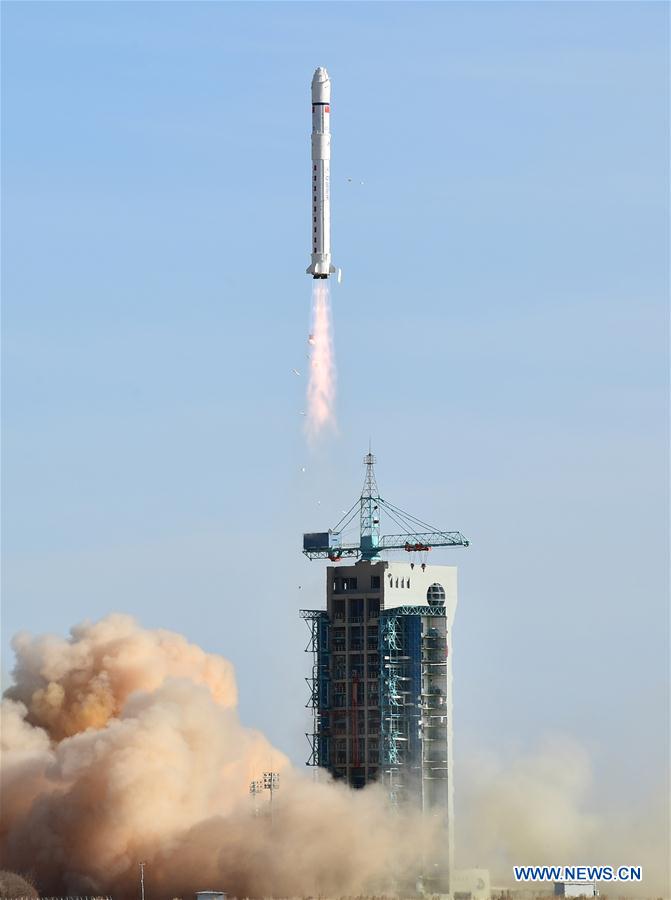
China launches its first seismo-electromagnetic satellite, known as Zhangheng 1 in Chinese, into a sun-synchronous orbit from Jiuquan Satellite Launch Center, in northwest China's Gobi Desert, Feb. 2, 2018. The satellite was launched to study seismic precursors, which might help establish a ground-space earthquake monitoring and forecasting network in the future. (Xinhua/Wang Jiangbo)
by Xinhua writers Quan Xiaoshu, Liu Wei
JIUQUAN, Feb. 2 (Xinhua) -- China on Friday launched its first seismo-electromagnetic satellite to study seismic precursors, which might help establish a ground-space earthquake monitoring and forecasting network in the future.
A Long March-2D rocket launched at 15:51 from Jiuquan Satellite Launch Center, in northwest China's Gobi Desert, carried the 730-kilogram China Seismo-Electromagnetic Satellite (CSES) into a sun-synchronous orbit at an altitude of about 500 kilometers.
Known as Zhangheng 1 in Chinese, it will help scientists monitor the electromagnetic field, ionospheric plasma and high-energy particles for an expected mission life of five years, said Zhao Jian, a senior official with China National Space Administration (CNSA).
The satellite is named after Zhang Heng, a renowned scholar of the East Han Dynasty (25-220), who pioneered earthquake studies by inventing the first ever seismoscope in the year 132.
Zhangheng 1 will record electromagnetic data associated with earthquakes above 6 magnitude in China and those above 7 magnitude around the world, in a bid to identify patterns in the electromagnetic disturbances in the near-Earth environment, Zhao said.
Covering the latitude area between 65 degrees north and 65 degrees south, it will focus on Chinese mainland, areas within 1,000 kilometers to China's land borders and two major global earthquake belts.
Zhangheng 1 was funded by CNSA, developed by China Earthquake Administration (CEA) and produced by DFH Satellite Co., Ltd., a subsidiary of China Academy of Space Technology (CAST).
Based on a CAST2000 platform, Zhangheng 1 is a cubic satellite, 1.4 meters on each side. It has a single solar panel and six booms, which will deploy and keep electromagnetic detectors more than 4 meters away from the satellite, said Zhou Feng, a senior manager with DFH Satellite Company.
It carries a high-precision magnetometer, a search-coil magnetometer and electric field probes to measure components and intensity of the magnetic and electric fields. It is also equipped with a Langmuir probe, a plasma analyzer, a GNSS occultation receiver and a tri-band beacon to measure in-situ plasma and ionospheric profile as well, Zhou said.
It also carries high-energy particle detectors, some of which are provided by Italian partners, and a magnetic field calibration device developed in Austria, according to Zhou.
DETECTING EARTHQUAKE PRECURSORS
China is one of the countries most affected by dynamic earthquakes, which are often widespread over terrain, high in magnitude and shallow in the epicenter.
However, scientists around the world are still unable to predict earthquakes despite efforts by various countries since the 1950s.
In recent years, more efforts have focused on monitoring seismo-electromagnetic anomalies in the near-Earth environment.
Research shows that just before a quake, tectonic forces acting on the Earth's crust emit electromagnetic waves and twist magnetic field lines. But such electromagnetic phenomena are relatively weak and need further study to be useful.
Zhangheng 1 will help scientists better understand the coupling mechanisms of the upper atmosphere, ionosphere and magnetosphere and the temporal variations of the geomagnetic field, and thus accumulate data for the research of seismic precursors, Zhao said.
"Zhangheng 1 cannot be used to predict earthquakes directly, but it will help prepare the research and technologies for a ground-space earthquake monitoring and forecasting system in the future," he noted.
Shen Xuhui, deputy chief designer of Zhangheng 1, said it will gather enough data to build models of the Earth's geomagnetic field and ionosphere, which are still unknown to China.
"Zhangheng 1, with a wider coverage and better electromagnetic environment from space, will be an important supplement to earthquake monitoring in Qinghai-Tibet Plateau and sea areas that cannot be fully covered by the ground observation network," said Shen, also chief engineer of the Institute of Crustal Dynamics of the CEA.
It will have access to more earthquake data, which will help identify patterns in pre-quake changes in the ionosphere via statistical analysis, Shen added.
EXTREME MAGNETIC CLEANNESS
In order to better detect the minor ionospheric changes caused by quakes and accumulate data on high-energy particles, plasma and electromagnetic fields, Zhangheng 1 must be extremely clean, which means it shall make the sensors free of its own disturbances in terms of magnetic fields and charging effects.
The mission requires the satellite's own magnetism be controlled within 0.5 nT, which is equivalent to 1/100,000 of the background magnetic strength on the orbit. Zhangheng 1's electromagnetic cleanliness eventually reached an unprecedented 0.33 nT, through structural and design optimization.
"We used hinged booms of nearly 5 meters with detectors on the far ends so as to decrease disturbances from the satellite platform. We also limited the use of magnetic materials, and ran strict simulation and magnetic tests to calibrate its data," said Yuan Shigeng, general director and chief designer of the satellite with CAST.
For example, engineers in charge of the data transmission subsystem spent four years minimizing its electromagnetic emissions, making sure the collected data will return to researchers accurately.
They had to find non-magnetic or low-magnetic materials for the system. "Many instruments and detectors in other satellites use steel screws, but we used less magnetic titanium screws instead," said Wu Zengyin, one of the satellite's main designers with CAST. "We also cut down the electric current loop area on the circuit boards so as to decrease their magnetic torque."
"Before the launch, satellites in orbit with high magnetic cleanness had all been developed by other countries, and Zhangheng 1 fills the gap," Yuan Shigeng said.
SO MANY BOOMS
The six booms were a great challenge, too.
No other domestic satellite had ever had so many booms, all reaching more than 4 meters on deployment, Yuan said.
As well as requiring magnetic cleanness, engineers had to find suitable special materials to enable the booms to withstand the enormous pressure of the launch, Yuan said.
"In space, the booms must remain still, and the location of their far ends moves no more than 2 millimeters, about the thickness of a coin, in temperature changes of over 200 degrees centigrade," he said.
The booms help broaden the distance between the sensors from 2 meters to over 10 meters, giving the small satellite platform more room for its payloads. Yuan believes the technology will have commercial satellite applications too.
Four of the outstretched sensors are electric field probes, like antennas, to detect changes in the electric field in three dimensions.
"The four probes are like wood blocks floating on water. They help us feel the waves from their movements. But they are extremely sensitive. They can detect a change as tiny as a drop of water in a wave as big as the Himalayas," Yuan explained.
Zhangheng 1 will run in-orbit tests for about six months to assess its data quality before it is formally put into service.
A second seismo-electromagnetic satellite is under evaluation, said Zhao Jian, the senior official with China National Space Administration.
Zhangheng 1 will also provide data services for weather forecasts, aerospace and navigation communications, space physics and geophysics research.
The rocket also carried six other miniaturized satellites, including Young Pioneer 1, China's first shared education satellite, a Uruguayan satellite and a Danish satellite.