




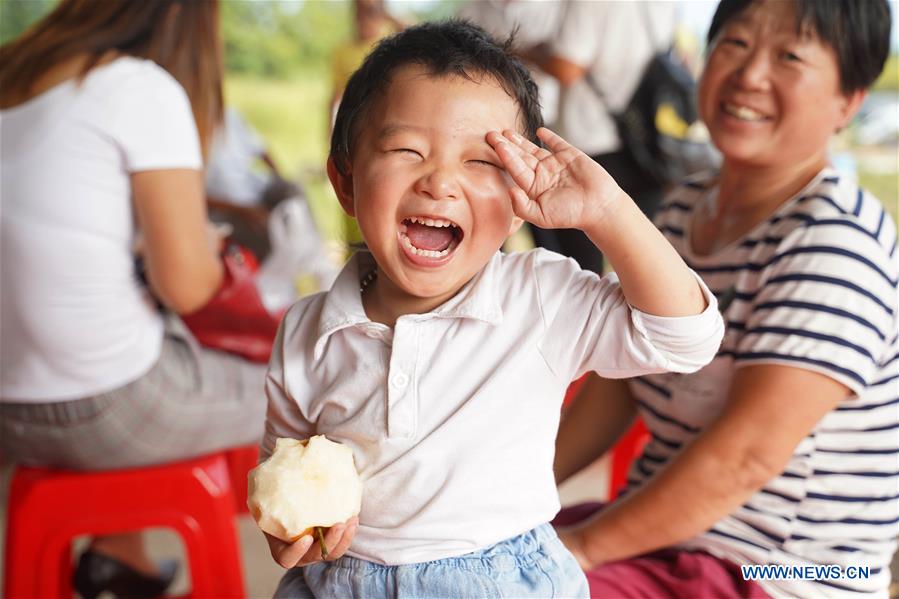
A smiling child eats pear at a pear planting base at Xiaogang Village in Fengyang County, east China's Anhui Province, on Sept. 15, 2018. (Xinhua/Cai Yang)
by Roisin Timmins
XIAOGANG, Anhui, Oct. 15 (Xinhua) -- At the height of harvest season in eastern China's Anhui Province, the rice fields around tiny villages transform into deep gold. Xiaogang is no ordinary village though, this place represents a turning point in China's modern history.
Xiaogang is in Fengyang (phoenix) county. The county, like its mythological namesake, has gone through hundreds of reincarnations over the centuries, as communities like Xiaogang battle a fickle environment to eke out enough food to survive.
Many villagers died of starvation during the great famine of the 1960s. This cataclysmic event left deep scars on those who saw it first hand, including Yan Hongchang.
By the autumn of 1978, Yan Hongchang had become Xiaogang's village leader. His village was already reliant on government aid for grain, and judging from the yields that autumn, that aid would be more needed than ever. Something had to be done.
At 30 years old, Yan was quite young for a village leader and perhaps his youth was one reason for his decision. It was time for a change, Yan decided, time to take control of the village's destiny.
A DESPERATE DECISION
One evening, 18 family heads came together for a covert meeting in one of the village's mud hut homes. They talked and argued and bemoaned their lot, and gradually, Yan Hongchang convinced them that his radical idea was their only choice: They agreed to de-collectivize their land.
Before I met Yan, I expected a strong character, probably loud and outspoken, but that was far from the case. He is strong, yes, still lithe and active, but there is a quietness to him. When explaining what happened that night, he speaks in low tones and doesn't really make eye contact.
"We were so scared, but there was no other choice," he says calmly. "So we kept it from the top, kept it to ourselves, kept it in the family and shared out the land."
They couldn't keep it secret for long. The collectivization of farmlands was an ideology that had been held firmly for decades. The division of land among households was extremely dangerous, it went against everything.
Through it all, Yan had his rock -- Duan Yongxia, his wife.
"She was scared, of course, but she supported me. She stood by me." Sometimes, however, this wasn't enough.
After a plentiful harvest in October 1979, the year after the meeting, he began to feel he may have made the right decision. But doubts plagued him for years. "My heart was heavy with anxiety. I kept thinking about what prison would be like, who would take care of my wife and children if I was executed."
It wasn't until early 1980s that land use reforms nationwide finally gave him a chance to breathe easy. At this point in the story, he visibly grows in confidence.
He describes how the mud hut we were in, preserved from the 1970s, was nothing but a distant memory of the lives they had led 40 years ago. Now he had plumbing, electricity and all the trappings of the modern world he could wish for.
His grandson, Yan Caishun, is in middle school, his older sister is in college, and he has big dreams. "I want to go to the UK," he declares. "I like playing football. Maybe I can study sport."
Such big ambitions were unimaginable just two generations ago. And all of the families who lived in the village at that time have experienced the same dramatic improvements.
FROM POVERTY TO PRIDE
At first glance, Xiaogang looks much like any other village in eastern China. Elderly men and women sit on porches. They aren't easily perturbed by the loud choruses of tour groups that periodically descend upon them.
One restaurant was full to bursting. It belongs to another Yan, Yan Jincheng, who was one of the 18 farmers at the meeting back in 1978. The kitchen is bustling in anticipation of the next tour bus. Around 20 hobs are fired up and woks are full of tofu, spicy chicken and bright green vegetables, sizzling under Yan's gaze. He points to the fresh vegetables on the shelves with pride, "all these come from Xiaogang."
Yan Jincheng is a naturally jolly man, and there's a glint of mischief in his eyes that makes him instantly likable. He's quick with a laugh even after all these years of journalists and tourists descending on him, asking for quotes and photos.
He also boasted about his children with typical parental pride. "I have seven children," he beams. "All of them have houses, all of them have cars." For someone born with so little, the things many of us take for granted have an almost ethereal meaning.
The simple explanation for Yan Jinchang's sunny disposition is the policies that have been gradually implemented since 1978 -- freedom from toil on collective farmland, and competition spurring unprecedented growth in production and profit.
But, as I left his restaurant, I experienced a strange mix of emotions. There was something about that mischievous spark, that pride in his children's successes, that gave me a sense of kinship with this old man. It wasn't until hours later that I realized why I had felt instinctively connected to this man born thousands of miles and two generations away from me.
My maternal grandfather was one of 10 children and they struggled every day to feed themselves. Several of his siblings died in childhood. My paternal grandmother was a tiny woman, undoubtedly as a result of living on bread and water for most of her childhood.
Poverty leaves a certain something behind the eyes, even after life gets more comfortable. My own grandparents had watched their children grow up to buy houses and cars, and live comfortable lives. Yes, their childhoods were haunted by poverty, but their parenthoods were filled with pride.
I saw that same glint, the spark of a survivor, in the eyes of Yan Jincheng, Yan Hongchang, and in the peaceful eyes of the elderly people who watched tourists press through their streets.
There's something about hardship and poverty that is written into the bones of the people in Xiaogang. The ghosts of the past still linger behind the eyes of the older generation, but they no longer haunt the children at play in Xiaogang Middle School's playground, dreaming of playing football in England.
