




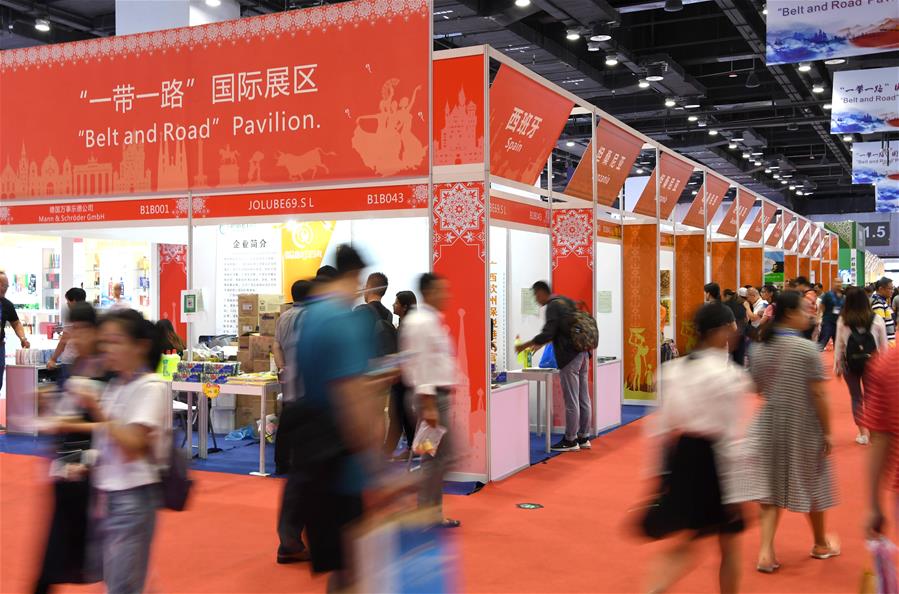
People visit "Belt and Road" Pavilion at the 15th China-ASEAN Expo in Nanning City, south China's Guangxi Zhuang Autonomous Region, Sept. 13, 2018. (Xinhua/Zhou Hua)
NANNING, Dec. 10 (Xinhua) -- Vietnamese and Chinese words are juxtaposed on signs and labels everywhere, and mountains tower over stacks of cargo in the Pingxiang Integrated Free Trade Zone in south China's Guangxi Zhuang Autonomous Region.
Trucks lumber through constantly, piling up at the border crossing, waiting to bring goods from Vietnam into China through the logistics park.
Nong Tuan, 26, an agent who coordinates between companies and customs, is zipping around the trucks on a Segway between the border checkpoints of China and Vietnam.
Every day Tuan makes dozens of trips between his native Vietnam and China. "Sometimes I need to charge my segway twice a day," he said.
"It's now a bustling place with more and more trucks coming, but when my father did border trade three decades ago, things were quite different," he said.
PAST & PRESENT
Guangxi marked its 60th anniversary on Monday. In the past decade, it has reshaped its image from an economic backwater to a booming border trade hub.
Home to the largest population of ethnic minorities in the country, Guangxi is among several border regions that are benefiting from China's greater opening up and the construction of the Belt and Road Initiative.
Before the start of reform and opening-up in 1978, China's border areas including Guangxi, Yunnan Province, Inner Mongolia Autonomous Region and Xinjiang Uygur Autonomous Region had been the most backward areas.
"Economic development had always been a headache for China's border areas due to harsh natural conditions such as rocky mountains, extreme cold, and desert," said Dai Yonghong, a professor with the Collaborative Innovation Center for Security and Development of Western Frontier China, Sichuan University.
Daeng Gwzginz, 94, in Dawu Village, close to the region's capital Nanning, remembers how poor life was 40 years ago.
"In the past, we only had corn or cassava as staple food. Rice was only for festivals," he recalled.
"Now that the old life is gone," he said. "We can eat whatever we like, and as for clothes, I can buy what I see fit. Life is so much better!" he said.
Guangxi's GDP reached 2 trillion yuan (296 billion U.S. dollars) in 2017, a world away from the 2.4 billion yuan in 1958, the year Guangxi became an autonomous region.
"China's border areas embraced development opportunities when the Chinese government listed 14 cities including Manzhouli, Hekou, Pingxiang and Dongxing of these areas as opening-up border cities in 1992," Dai said.
For example, Inner Mongolia, which celebrated its 70th anniversary last year, expanded its GDP to 1.86 trillion yuan in 2016, 642 times of that in 1947.
The region's foreign trade volume has also increased from 30 million yuan to 77.3 billion yuan since China's reform and opening up. In recent years, the sharp increase in China-European freight trains traveling via Erenhot and Manzhouli ports has boosted China-Mongolia and China-Russian trade.
Xinjiang saw its GDP growing more than 110 times when it celebrated its 60th anniversary in 2015.
Serving as China's northwest doorway to central and west Asia that sits at the center of the ancient Silk Road, the region also registered a foreign trade of 3.3 billion U.S. dollars, up 24.2 percent year on year in the first two months of 2018, according to customs statistics.
The region's trade volume with Kazakhstan hit 1.4 billion U.S. dollars, a year-on-year growth of 47.7 percent, and saw an increase of 170 percent in its trade volume with Russia, and a growth of 56.5 percent with Uzbekistan in the same period.
BORDER TRADE & OPENING-UP
Trieu A Lien, 56, is a Vietnamese who has studied, worked, got married and lived in Nanning after she came to the city with her parents at the age of five.
"Ports in Guangxi became more open to the world in 1992, and I can speak Vietnamese, Mandarin Chinese, and Cantonese, so I decided to look for a business opportunity in the border city Pingxiang," she said.
Lien joined border trade by selling piece goods. She started her regular trips from Nanning to Shanghai by train to replenish her stock, and she would then take the goods to Vietnam via the border port.
"The manufacturing industry has been developing fast in China, with a booming market and various kinds of products," she said.
In Lien's eyes, the China-ASEAN Expo that started in 2014 is the biggest watershed for Guangxi's development. "Great changes have taken place since then," she said.
Over the past 14 years, the expo has helped expand China-ASEAN trade.
With the expo, products from ASEAN countries such as coffee, durian products, jewelry, and jade are entering the Chinese market, and China's manufacture and infrastructure companies including Guangxi Liugong Group Co., Ltd., SAIC-GM-Wuling Automobile Co. (SGMW) and China Road and Bridge Cooperation(CRBC) are entering the ASEAN countries at the same time.
"Thanks to the expo, in only four years, Beerlao went from unknown to popular in China," said Phengrattanavong Khomsone, manager of the Beerlao brewery.
In the past, due to lack of channels, Beerlao was not able to enter the Chinese market, but in 2012, Khomsone found Chinese partners when he brought Beerlao to the ninth China-ASEAN Expo.
"Now, China has become Beerlao's biggest overseas market, accounting for about 70 percent of our company's market share," he said.
Statistics show that trade volume between China and ASEAN countries has increased from over 100 billion U.S. dollars in 2004 to 514.8 billion U.S. dollars in 2017. China has been ASEAN's biggest trading partner for nine consecutive years, while ASEAN has been China's third largest trade partner for seven years in a row.
Trade volume between Guangxi and ASEAN has increased from 5.21 billion yuan to 189.38 billion yuan, with an annual growth rate of 27.1 percent in the past 15 years. ASEAN has been Guangxi's biggest trading partner for 17 consecutive years.
CONNECTING TO THE WORLD
"In recent years, the China-South Asia Expo, China-Eurasia Expo, and China-Northeast Asia Expo have also been held, creating important platforms for China's border areas to further open up and develop its economy, and laying a solid foundation for the Belt and Road Initiative," said Zhai Kun, a professor of international relations at Peking University.
"After the Belt and Road Initiative was proposed, the opening-up of China's border areas has started to upgrade. Provinces and regions such as Yunnan, Guangxi, Xinjiang and Inner Mongolia have further opened up, with obvious spillover effects," he said.
Yunnan, the neighboring province of Guangxi, has also benefited from reform and opening-up, playing an important role in China's opening-up to south and southeast Asia.
With the construction of road and railway between China and Vietnam, Laos, and Myanmar, a transportation network connecting China with south and southeast Asia has begun to take shape.
"Laotians will be able to take a high-speed train to China and Thailand in several years," said Somsavat Lengsavad, former Deputy Prime Minister of Laos at this year's China-ASEAN Expo. "The Belt and Road Initiative is changing the geographic status of Laos and boosting infrastructural construction along the railway."
Boasting both sea and land links with Southeast Asia, Guangxi has cast itself as an important gateway to ASEAN countries and plays a key role in the construction of the Belt and Road Initiative to build trade and infrastructure networks connecting Asia with Europe and Africa based on ancient land and maritime trade routes.
Guangxi's Beibu Gulf is an important transit in the New International Land-Sea Trade Corridor that connects western China and Southeast Asia with sea and rail intermodal routes. Ship routes link the gulf with over 200 ports in the world, including all the major ports in ASEAN.
Local statistics show that a total of 697 freight trains carrying 35,060 containers were launched in the first three quarters of this year. Now, there are regular cargo ship services from Beibu Gulf to Hong Kong and Singapore.
Le Thi Huong, Vietnamese, came to work for a food sales company in Dongxing, a city on the China-Vietnam border in 2015.
"I can speak Chinese, so I help manage workers from Vietnam in the company. I'm now earning more than one and a half times what I did in Vietnam," she said.
Currently, a total of seven cross-border economic cooperation zones between China and Vietnam are under construction, said Jiang Liansheng, chief of the regional commerce department of Guangxi.
As a significant part of the construction of the Belt and Road Initiative, China and Vietnam launched the cross-border labor service cooperation in 2015.
"As a result of the cooperation, the Vietnamese living around the China-Vietnam border can travel between the two countries freely with border resident certificates," Jiang said.
At present, over 100,000 Vietnamese nationals are working in the border cities of Pingxiang and Dongxing in Guangxi, which has helped relieve the labor shortage of the enterprises in the border areas.
SGMW, based in the city of Liuzhou, is an important automobile manufacturer in China. With an investment of 700 million U.S. dollars, SGMW built a factory in Indonesia in July 2017 with an annual output of 120,000 automobiles.
Over 20 enterprises in Guangxi have invested to construct factories in Indonesia. SGMW's factory in Indonesia has created more than 3,000 jobs for local people, said Lian Chaochun, vice-general manager of SGMW.
Wang Yuzhu, executive dean of the China-ASEAN Research Institute of Guangxi University, said the increased investment from enterprises in Guangxi to countries along the Belt and Road routes would boost the economic development of these countries and create more jobs there.
"The Belt and Road initiative emphasizes both land and maritime transportation, of which China's border areas are a crucial part. China's border areas are at the forefront of opening-up and will play an even bigger part in the future," Zhai said.
