Xinhua Headlines: China, ASEAN to upgrade free trade, bring more certainties to world

* Being each other's largest trading partner for the fifth consecutive year, China and ASEAN have scored numerous achievements amid rising external uncertainties.
* Beyond trade, the China-ASEAN economic cooperation has also expanded into deeper integration of industrial and supply chains.
* From large-scale infrastructure cooperation to daily travel and consumption, closer exchanges between Chinese and ASEAN people are reinforcing trust, understanding and friendship.
KUALA LUMPUR, Oct. 26 (Xinhua) -- As Chinese and ASEAN leaders gather here this week, a planned upgrade of the China-ASEAN Free Trade Area comes into the spotlight.
Within this year, the two sides will formally sign the China-ASEAN Free Trade Area 3.0 Upgrade Protocol, empowering regional economic integration and global trade, Chinese Foreign Ministry spokesperson Guo Jiakun said on Wednesday.
Being each other's largest trading partner for the fifth consecutive year, China and ASEAN have scored numerous achievements amid rising external uncertainties. In the first three quarters, China's trade with ASEAN totaled 5.57 trillion yuan (about 785 billion U.S. dollars), up 9.6 percent year-on-year, with events such as the China-ASEAN Expo successfully held.
New achievements coincide with the adoption of the Plan of Action to Implement the China-ASEAN Comprehensive Strategic Partnership (2026-2030), which aligns highly with the ASEAN 2045: Our Shared Future and its Strategic Plans. Standing at a new starting point, the region is broadening collaboration on infrastructure, digital and green transition, trade facilitation and people-to-people exchanges, paving the way for deeper regional integration.
NEW CONNECTIVITY
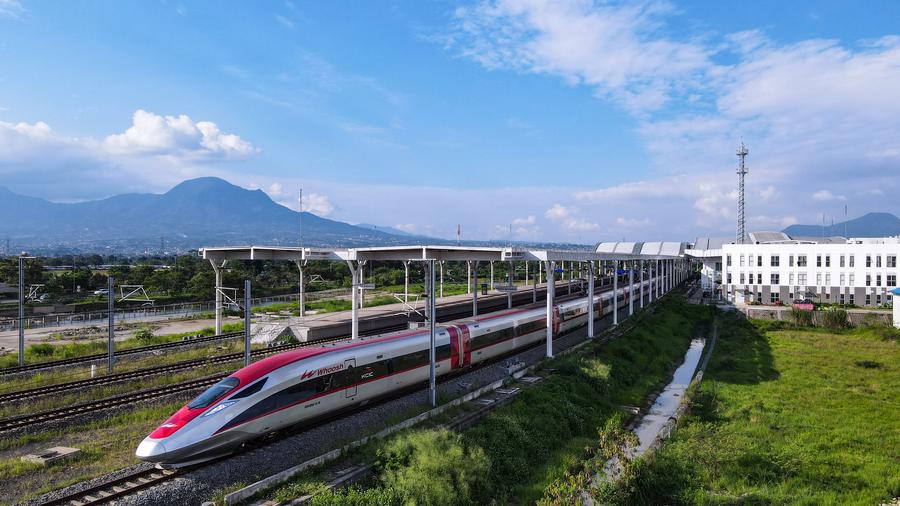
Since their operation, the Jakarta-Bandung High-Speed Railway in Indonesia and the China-Laos Railway have played an indispensable role in regional connectivity and mobility under the Belt and Road Initiative, largely reducing the cost of logistics and transportation.
Going through the 16.39-km Genting Tunnel, the Malaysia's East Coast Rail Link carries high expectations for regional connectivity and integration. Touted as a "game changer" for the movement of passengers and freight in Peninsular Malaysia, this milestone infrastructure project will link key cities and hubs, intertwining with existing railway nets along the corridor.
Beyond rail links, the next chapter of connectivity is unfolding in the sky. The Zhengzhou-Kuala Lumpur "Air Silk Road," a strategic air cargo partnership, has added another dimension to the ASEAN-China integration in facilitating logistics and streamlining cross-border e-commerce flows.
In August 2024, the first flight loaded with fresh durians touched down at the Xinzheng International Airport in China's central city of Zhengzhou. "Now, a naturally ripened Musang King durian can reach Chinese consumers within 36 hours of harvest. This was unimaginable just a few years ago," Zhang Jianhao, secretary-general of the Malaysia International Durian Industry Development Federation, told Xinhua.
"This critical cooperation highlights the advantages of the 'dual hub' model," said Malaysian Transport Minister Anthony Loke Siew Fook. "Thanks to the Zhengzhou airport's 'green channel' and 'zero-wait' customs clearance policies, Malaysian durians can enter the Chinese market efficiently. Meanwhile, Chinese cross-border e-commerce goods are also rapidly being exported to Southeast Asia, gradually forming a two-way model of 'durians entering China, e-commerce goods going global.'"
"ASEAN must seize this opportunity. This is why I encourage our logistics companies, especially local airlines and ground handling companies, to be more proactive in connecting with partners in the ASEAN region, consolidating more ASEAN products for export to China," he said.
STEADIER COOPERATION
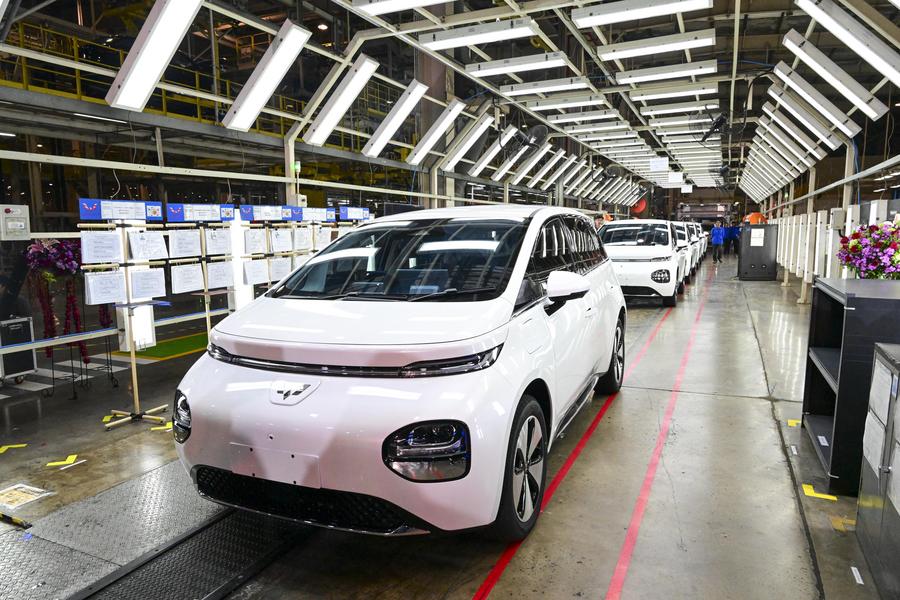
Beyond trade, the China-ASEAN economic cooperation has also expanded into deeper integration of industrial and supply chains. As the first Chinese automaker to invest and establish a factory in Indonesia, SAIC-GM-Wuling (SGMW) has helped 17 Chinese enterprises in the auto supply chain to venture into ASEAN's biggest economy, developing over 100 local suppliers over the past seven years.
"Now in Indonesia, Chinese electric vehicles (EVs) are everywhere," said Humprey Arnaldo Russell, head of the ASEAN-China Research Center of the University of Indonesia. "I see it as a very positive development. In the next 10 to 20 years, I believe we may even collaborate with China to produce electric vehicles locally."
There is much more ASEAN can learn from China's experience, especially in technology and green energy, where China has already taken the lead, Russel said, adding that China has already played an important role in ASEAN's economic growth and its continuous development will remain a powerful engine for the region.
In July, the groundbreaking of a new EV battery megaproject in Indonesia set another milestone in the archipelagic country's rapidly growing EV supply chain, driven by Chinese investment. The project covers the full supply chain, from nickel mining and processing to battery materials production, manufacturing and recycling.
Such green energy initiatives, also including a 60MW floating solar power project undertaken by a Chinese company in the country, aligned perfectly with Indonesia's long-term commitment to achieving net-zero emissions by 2060.
This transformation is "more than an energy transition," said Fahmy Radhi, an energy economics expert from Gadjah Mada University. "It opens the door to clean technology, encourages green infrastructure development, and provides a strategic path for Indonesia to become a clean-energy industrial nation."
CLOSER EXCHANGES
From large-scale infrastructure cooperation to daily travel and consumption, closer exchanges between Chinese and ASEAN people are reinforcing trust, understanding and friendship.
Looking back to the early days of the Jakarta-Bandung High-Speed Railway project, the trust-building and deepening of understanding stories between Chinese and Indonesian teams still moves Zhang Chao, the executive director of the PT Kereta Cepat Indonesia China -- handing out red envelopes to Indonesian staff to celebrate the Lunar New Year together, and seeing Indonesian teammates making mooncakes for their Chinese colleagues during the Mid-Autumn Festival, etc.
Zhang said that's the time for him to know that cultural recognition, friendship and mutual trust were taking root.
Such momentum is also felt every day across the region, as frequent people-to-people exchanges are knitting markets and communities together.
The live experience of Chinese travelers across ASEAN countries may be like this: with Chinese eateries and a growing constellation of beverage brands such as Mixue and CHAGEE, retail shops like POP MART and MINISO are all contributing to a sense of family. The tourists might feel as if they haven't left home.

After China's mutual visa-exemption agreement with Malaysia took effect on July 17, Lee Thai Hung, deputy director general of Tourism Malaysia, promptly took to live-streaming rooms on major Chinese platforms such as Trip.com, Meituan, and Fliggy to showcase Malaysia's distinctive culture, cuisine and travel experiences to Chinese netizens.
"We plan to attract 47 million international visitors in 2026 and generate 329 billion ringgit (about 77 billion dollars) in tourism receipts," Lee said. "We are confident that continued growth in Chinese arrivals will help Malaysia achieve this target and play a pivotal role in further strengthening Malaysia-China economic and trade relations."
Currently, China has mutual visa exemption agreements with Singapore, Thailand and Malaysia for ordinary passport holders, allowing stays of up to 30 days per entry. Additionally, China has granted mutual visa-free entry to Brunei and rolled out the "ASEAN Visa" for eligible business personnel from all ASEAN countries, making cross-border movement in the region more seamless.
(Video reporters: Yu Lizhen, Zu Er, Tan Yaoming, Jonathan Edward; Tang Peipei, Zhang Yisheng, Li Sibo; video editors: Wei Yin, Zhao Tianlin, Zhang Yicheng)■









Comments