by Xinhua writers Han Qiao and Qu Ting
BEIJING, May 12 (Xinhua) -- Wang Cunjin, 61, a farmer from a village in north China, never thought he would go abroad and help discover a lost ancient city, thousands of miles from home.
For the past two years, Wang has joined a Chinese archaeological team in Uzbekistan each fall and spent more than two months there digging at the Mingtepa ruins in the Fergana Valley.
His unique skill of digging underground with a traditional Chinese tool called a Luoyang shovel has amazed local archaeologists, who have less experience doing archaeological work where there are no signs on the ground surface.
The joint archaeological team from the Chinese Academy of Social Sciences (CASS) and its Uzbekistan counterpart has made significant finds as they unearthed an ancient city, almost the size of Monaco.
They found that about 2,000 years ago, Mingtepa was an important city in the Dayuan state, a state known for the precious Fergana horse breed and a key hub on the ancient Silk Road.
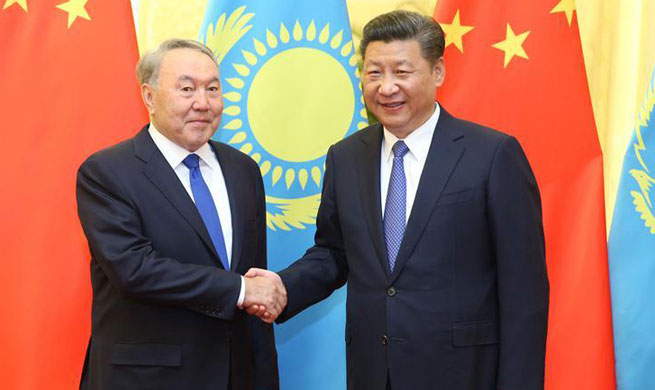
Chinese President Xi Jinping mentioned the joint archaeological work last June, when he published a signed article in Uzbek media ahead of his state visit to the Central Asian country.
"The State Administration of Cultural Heritage of China, the Chinese Academy of Social Sciences and the Northwest University of China have worked actively with Uzbekistan on joint archaeological research and restoration, making important contributions to restoring the historical sites of the Silk Road," Xi wrote.
This January, the project won a Major Overseas Archaeological Discovery of 2016 award from the CASS.
SEEKING A BREAKTHROUGH
The ancient Silk Road was a conduit for trade and exchange about 2,000 years ago. It is drawing more attention nowadays, as the Belt and Road Initiative was proposed by China in 2013 as a trade and infrastructure network to better connect Asia with Europe and Africa.
China will host the Belt and Road Forum for International Cooperation on May 14 and 15 in Beijing.
"Culture exchange and cooperation consist an important part of the Belt and Road Initiative," said Chen Xingcan, director of the Institute of Archaeology with the CASS. "Evidence from the archaeological work will help countries along the ancient route learn more about the history."
Today, Chinese and foreign archaeologists are teaming up to rediscover the history in the ancient Silk Road.
The Mingtepa ruins have seen intermittent excavations for decades. Part of the city walls have been unearthed, circling an area 500 meters by 800 meters.
But there have been guesses that the city could be larger and there were undiscovered outer walls.
In 2011, the Institute of Archaeology of the Uzbekistan Academy of Social Sciences and the Institute of Archaeology with the CASS signed a deal to jointly excavate the site.
The work started the following fall, but the Chinese team did not rush to dig.
The team, headed by Zhu Yanshi, a specialist in the archaeology of ancient capitals, spent three years drawing a digital map of the site, with the help of drones, and using technology of precision measurement and computer mapping.
In 2015, Zhu invited his old partner Wang Cunjin, who is skilled in using the traditional Luoyang shovel, to the site.
A U-shaped cylinder four to six centimeters in diameter, the Luoyang shovel is widely used in Chinese field archaeology. It lets the user extract a section of earth while preserving the soil structure.
Researchers can analyze the color, texture and intensity of soil for any evidence of underground structures, to find if it is soil from a road, a tomb or a city wall. Usually, the soil of a city wall is hard and firm.
At the Mingtepa site, archaeologists started to look for the outer walls of the city, but with no signs on the surface. It was like trying to find a needle in a haystack.
The Chinese team recruited 12 Uzbek farmers, and Wang taught them how to use the shovel.
Every day the farmers dug small holes, and Wang examined the extracted soil from each hole.
Another colleague put the position information of the holes and soil information into the digital map previously drawn. The position data was collected using the Real Time Kinematic technique, which provides centimeter-level accuracy and is more precise than GPS.
Wang found the texture of the soil was quite different from that in China.
"Some soil is very soft. In China, you would not think it is soil on the city wall. But here as we made more comparisons between different soil samples, we found some soft soil was a bit unusual and it might be what we were looking for," Wang said.
Every evening, Wang and his colleagues compared soil samples from different holes and discussed possible locations of the city walls.
A breakthrough was made in the fall of 2016. Signs indicated that there might be a city wall in the eastern part of the ruins.
Zhu decided to dig a small pit in the area - and they found the outer walls.
"Once we made the breakthrough, it became easier to trace the wall," Zhu said.
The outcome amazed the Uzbekistan team.
"You are not only a technician. You are a real expert," Bokijon Matbabaev, leader of the Uzbekistan team, told Wang.
Following excavations found outer walls of the city in the other three directions. It broadened the site size from 500 by 800 meters to 2,100 by 1,300 meters, meaning that about 2,000 years ago it was the largest city in the Fergana Valley.
The team also unearthed a craft workshop and a graveyard. There have been guesses that Mingtepa was simply a temporary garrison fort for nomads. The workshop and graveyard came as proof that Mingtepa was an ancient settlement.
"With such a large area and the structure of both the inner city and external city, Mingtepa must have been an important city in the Dayuan state around 2,000 years ago," Zhu said.
"The outcomes of the excavations in the past five years were more than we achieved in recent decades," Matbabaev said.
"China' s cultural heritage is rich, so Chinese archaeologists have accumulated great expertise and experience in field archaeology," said Wang Wei, then director of the CASS Institute of Archaeology.
RESPECTED TALENT
Working in Uzbekistan is a unique experience for Wang, who never had the chance to mingle with foreigners at home.
"I find Uzbekistan farmers are very, very polite and good mannered," Wang said. "They often hug each other. They greet me politely every day. That really impressed me."
Wang did not go to college and was a farmer until he learned his Luoyang shovel skills at the age of 27. His skills have been honed over years of excavation work.
In Uzbekistan, as he made important discoveries, he was seen as a talented person and became famous. The excavation site was open to local people and students. Once, a college student even asked for his signature.
"I never had that experience before. I did not know what to write. Finally, I wrote 'study hard,'" he said.
Wang has few hobbies, and in Uzbekistan he rarely went shopping, but he did buy one item to take home.
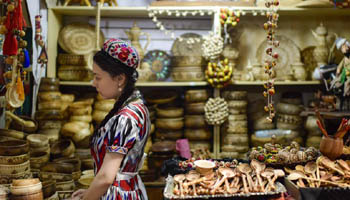
"It was a plate. It had beautiful patterns. The local culture is admirable," Wang said. "Now I serve fruits on the plate when guests come to my home."
MORE COOPERATION
"In 2011, Mingtepa was the first foreign project of China's state-level archaeology institute," said Wang Wei.
"Since China's reform and opening-up policy was adopted, archaeological teams from about a dozen countries have come to China for more than 70 collaborative projects. But this is the first time a state-level archaeology agency had gone abroad."
Five years on, the project showcases the strength of Chinese archaeology.
China now has several archaeological teams engaged in overseas joint projects, such as in Vietnam, Cambodia, Laos, Pakistan, Uzbekistan,Tajikistan, Kazakhstan, Kyrgyzstan, Iran, Egypt, Kenya, and Honduras.
The CASS established a research center focusing on archaeology work abroad in March.
"China has advantages in archaeological work along the Silk Road," said Wang, director of the newly-established center.
"Chinese books have historical records on many countries on the route. Civilizations influenced each other along the road. Some antiques unearthed are very strange to European archaeologists, but Chinese experts recognize them easily," Wang said.