by Xinhua writer Liu Chang
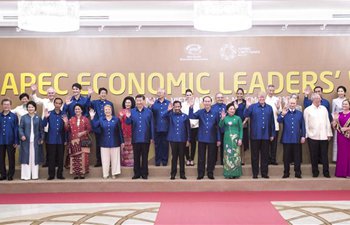
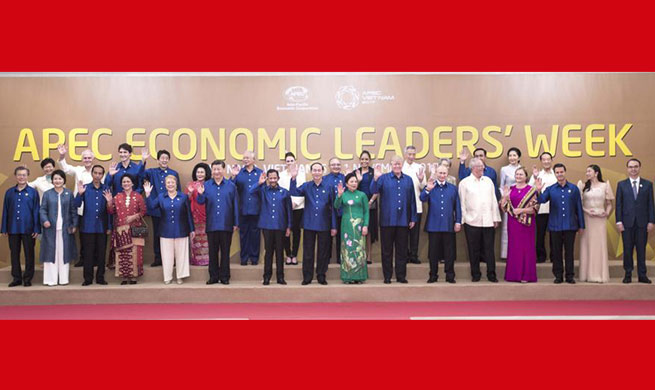
BEIJING, Nov. 11 (Xinhua) -- The logo of this year's Asia-Pacific Economic Cooperation (APEC) meeting in Vietnam shows 21 sunrays moving in a circular motion, symbolizing the spirit of cooperation among the bloc's 21 member economies.
That spirit seems to be more imperative than ever as the global economy still struggles to recover almost a decade after the 2008 global financial crisis struck, while trade protectionism is still on the rise across the world.
RISK OF PROTECTIONISM
Over the past 10 years, despite a lackluster global economic recovery, the Asia Pacific has remained as the world's most economically exuberant region and the main engine of global growth.
Chang Yong Rhee, director of Asia and Pacific Department at the International Monetary Fund (IMF), told a press conference on the sidelines of the IMF/World Bank annual meetings last month that Asia's contribution to global growth is about 63 percent while China alone accounts for 34 percent.
This year, heads of state and other senior government officials of the APEC members gather in the Vietnamese coastal city of Da Nang at a time when the global economy has shown a broad-based upswing while World Trade Organization forecast that global trade is expected to rebound this year.
The IMF said in its 2017 World Economic Outlook that global recovery is continuing and at a faster pace. It revised its global growth projections to 3.6 percent for this year and 3.7 percent for next.
However, APEC leaders are facing a no less complex situation than that in previous years as they still need to cope with various pressing global challenges in efforts to sustain the region's jubilant momentum.
One major task is to renew the spirit of free trade and resist the temptation of protectionist approaches.
According to the Pacific Economic Cooperation Council (PECC) annual survey of opinion leaders released on Tuesday, rising protectionism was seen as the top risk to growth of the Asia-Pacific region.
The IMF also warned in its economic outlook "a shift toward protectionism would reduce trade and cross-border investment flows, harming global growth."
"Preserving the global economic expansion will require policymakers to avoid protectionist measures and to do more to ensure that gains from growth are shared more widely," added the IMF report.
STRONGER COOPERATION
The APEC forum was born in 1989 to promote free trade and economic integration and cooperation among all of its Pacific-rim economies. The APEC meeting this year falls under the theme of "Creating a new dynamism and a shared future."
To do that, the member economies, which host a combined population of 3 billion and 60 percent of the world's total gross domestic product, need to uphold the very spirit of cooperation that has been deeply embedded in the gene of the group.
Over the years, APEC members have jointly reduced trade barriers between them, harmonized standards and regulations, and streamlined customs procedures to enable a more smooth movement of goods across borders.x APEC members have also worked together to facilitate business transactions in the region so that it would be much simpler to start a company in the region.
In a new era where economic development needs call for inclusiveness, and where global governance needs to be improved to better deal with such daunting global challenges as climate change, APEC has a new and more important role to play.
In an article titled "APEC must lead the march for inclusive and sustainable growth" written earlier last month, Zhang Jun, director general of the Chinese foreign ministry's international economics department, wrote: "Member economies should act on the principle of inclusiveness and shared benefits, addressing the special needs of the developing economies among them and creating an enabling environment for their participation in regional cooperation."
In this article published in the South China Morning Post, Zhang also wrote that APEC should continue to encourage greater connectivity as an effective instrument to break development bottlenecks and achieve inclusive growth.
FTAAP FOR INCLUSIVE TRADE
Promoting more inclusive cooperation in free trade in the Asia-Pacific should also be a top priority for APEC members, and the notion of "Free Trade Area of the Asia-Pacific" (FTAAP) has been increasingly accepted as an ideal model for boosting trade as well as regional integration.
In fact, the FTAAP is a not new idea, nor was it first brought onto the table by China. It was first proposed in 2004 and written into the declaration of the APEC leaders' meeting in 2006. During the 2014 APEC meeting in Beijing, APEC member economies pushed forward the FTAAP process and sketched a roadmap for it.
Compared with other plans for a regional free trade regime, the FTAAP stresses inclusiveness, seeks greater regional economic integration and could unleash enormous potential for fast economic growth and balanced wealth distribution.
Experts also believe that the FTAAP is an effective way to reduce the "spaghetti bowl effect" caused by various overlapping regional trade arrangements, and fragmentation risks.
A report from the Pacific Economic Cooperation Council (PECC) estimates that the FTAAP, when realized, will add 2.4 trillion U.S. dollars to the global economy.
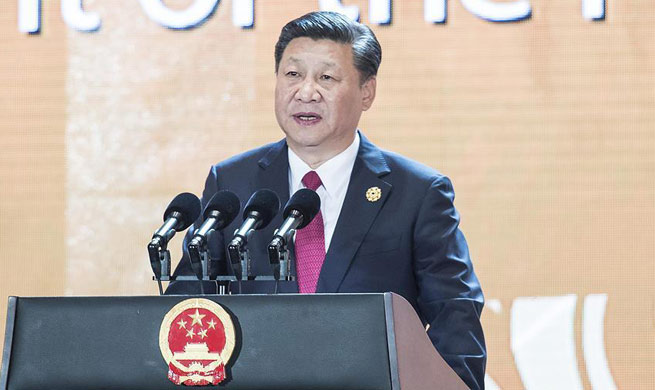
In his keynote address titled "Seizing the Opportunity of a Global Economy in Transition and Accelerating Development of the Asia-Pacific" at the APEC CEO Summit held in Da Nang, Chinese President Xi Jinping said the building of the FTAAP has been "the long-cherished dream of the business community in our region."
"We should get into action, fully implement the Beijing Roadmap, move toward the FTAAP and provide an institutional underpinning for growing an open economy in the Asia-Pacific," the Chinese leader said.
Jin Jianmin, senior fellow at Fujitsu Research Institute in Tokyo, said the "FTAAP as a long-range objective for market integration of the Asia-Pacific region, is bound to be welcomed by the majority of countries in the region."