URUMQI, Nov. 6 (Xinhua) -- Amudun Ebudun is sad that he is one of the last few fishermen in the mysterious Lop Nur lake area, located at the rim of China's largest desert Taklimakan and also known as the "sea of death".
The 60-year-old man's family is among the last 40 aboriginal families living deep in the area famous for its dried-up lake, Lop Nur. Since the lake dried up in the 1970s, the 10,000 square-kilometer area has become a vast salt-encrusted lake bed secluded in the deserts of the southeastern areas of northwest China's Xinjiang Uygur Autonomous Region.
Today, most Lop Nur people have forsaken this traditional way to make a living. Many fishermen have become herders, farmers or shop owners, or moved to nearby towns.
"There were fewer and fewer lakes around in the 1980s. The water had gone. So had the fish. So people had to turn to other means of income," says Amudun.
Excessive irrigation in the past used too much water, which caused the lower reaches of the Tarim River, China's longest inland river, to run dry in the early 1970s and push surrounding trees to the verge of disappearance.
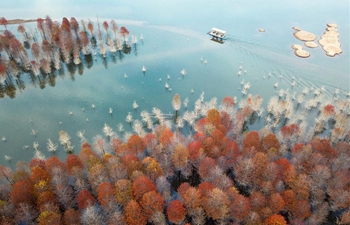
Situated where the Tarim River's middle reaches and the Taklimakan Desert meet, Amudun's village is dotted within an oasis, poplar forests, ponds and lakes in the vast sand. The landscape carries a paradoxical resemblance to the Italian city of Venice, which gives the people here a paradoxical way of living -- fishing in the desert.
"I come from the Tarim River, where fish swim about happily. It's a sleepless night for me, for I miss you, my beloved girl," Amudun, while fishing, sings a traditional folk song passed down generation after generation.
Amudun fishes the same way his parents and their parents did. He usually rows his canoe on his own to the middle of the lake, and catches fish with a trident. Despite the shallow water, it's not easy to spear the fish due to light refraction. But a skilled hand like Amudun can easily catch some 10 fish a day. Sometimes he also casts a net, a new tool Amudun didn't use until recently.
To improve the local eco-system, the government launched a restoration project in 2000. Around 7.6 billion cubic meters of water was transfused from the upstream parts of the Tarim River. More plants began to take root along the river as a result, and animals came back, too.
"The water is back, and some people have returned to the old trade. Lop Nur people still love fishing," says Amudun.
Locals say they are descendants of the people who once lived in Loulan, an ancient Silk Road civilization that was nurtured and nourished by the vast Lop Nur around the third century BC and mysteriously disappeared around the third century AD. However, as the Tarim River, which supported the settlement, changed course, Loulan people had to abandon the area and move upstream due to a lack of water. Secluded in the vast sand, the Lop Nur people were not found by outsiders until the 1750s.
Seclusion between the dunes has preserved the most of Lop Nur people's traditional lifestyle, but as a road was built years ago to connect the village with the outside world, they soon began to embrace modern life. Amudun has even bought a motorcycle and a cellphone, while his family has opened an eatery selling authentic Lop Nur-style grilled fish with Amudun's fresh catch.
To make the dish, the fisherman threads the whole fish onto a skewer made of salt cedar branch, grills the fish by the fire, and seasons it with only salt to preserve the fresh, natural flavor. He has also developed a secret sauce for customers who prefer a stronger flavor.
Their business is getting better as more tourists become attracted by the area's improved environment. Xinjiang's tourism industry has boomed in recent years. In 2017, the region registered more than 100 million trips by domestic and international tourists collectively, a year-on-year growth of 32.4 percent.
Amudun says he fishes not only to make money but also to promote the traditions of Lop Nur people.
"Young people now want to live in the cities. But I have taught my son and my grandson fishing. Even though one day they will move out of the village, they must pass on this tradition," says the fisherman.
When the eatery is not busy, he leaves it to his wife and his son, and goes fishing dressed in what he calls "heirlooms" -- a Lop Nur-style long linen robe and a boat-shape woolen hat.
This attire brings him big fish and fortune, he says.