
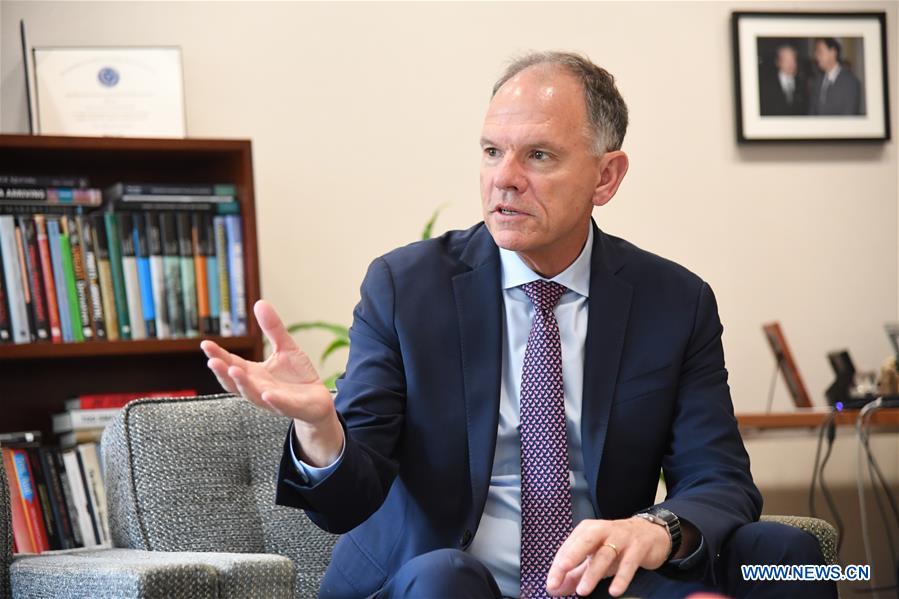
Geoffrey Garrett, dean of the Wharton School at the University of Pennsylvania, speaks to Xinhua during an exclusive interview in Philadelphia, the United States, April 19, 2019. Technology competition between the United States and China won't lead to so-called "decoupling" because the two economies are "tightly integrated," said Geoffrey Garrett. (Xinhua/Yang Chenglin)
by Xinhua writers Xiong Maoling, Gao Pan and Yang Chenglin
PHILADELPHIA, the United States, May 2 (Xinhua) -- Technology competition between the United States and China won't lead to so-called "decoupling" because the two economies are "tightly integrated," said Geoffrey Garrett, dean of the Wharton School at the University of Pennsylvania.
"DUAL-USE" CHALLENGE
"There's going to be a lot of (U.S.-China technology) competition because the stakes are so high in a lot of these advanced technologies," Garrett told Xinhua in a recent interview.
Noting the innovation in "dual-use" technologies, which means they have a commercial and also potentially a military application, Garrett said this makes the technology competition between the two countries "more challenging."
In the last 20 or 30 years, the use of national security as a reason to stop free movement of goods has been very rare, Garrett said. However, in the past five years, "we've had much more use of national security justifications to restrict trade," he said, calling it "troubling."
Citing the example of the Trump administration's steel and aluminum tariffs, Garrett said "that's a very extreme position that runs counter to the whole globalization ethos."
"I would certainly hope over time that would go down, not go up," said Garrett, a reliance professor of management and private enterprise and professor of management at the Wharton School.
Speaking of Chinese telecom giant Huawei, Garrett said that for many countries in the world, whether to use Huawei for 5G backbone is not actually a choice because the decision has already been made. "Huawei equipment is relatively cheap and good. So a lot of emerging markets have used it."
COMPETITION DOESN'T MEAN DECOUPLING
Despite concerns about growing U.S.-China technology competition, the dean, who is also professor of political science at the University of Pennsylvania, believes that the so-called "decoupling" between the two countries is "not going to happen."
"The ties between U.S. and China are so tight. How could you actually decouple it?" Garrett said. "I don't want to be naive about this, but I think the economic incentives, the fact that these two economies are so tightly integrated and that because of that decoupling them would be economically disastrous."
"It would be terrible for America, terrible for China, terrible for the world economy," Garrett said. "I think it's in everyone's interest to manage down the tension."
In an earlier blog, the dean said it is clear that the two economies are "complementary" where innovation is concerned. "This makes cooperation so much better than conflict," Garrett said.
His view was echoed by a group of experts in a discussion at the 2019 Penn Wharton China Summit held in April, who said that the two countries should utilize their respective advantages and enhance cooperation in technology.
Garrett said that China has been rapidly turning ideas into outcomes at scale, and in that sense, China is certainly an innovation economy.
Calling China a global leader in high-speed railway, mobile payment and electric vehicles, the dean said that China's innovation is "really impressive" and "very powerful."
Garrett also highlighted Chinese companies' innovation in areas such as health care, insurance and autonomous vehicles, adding that he believes there is less regulation and "greater possibility" in innovation in China.
"There is a real chance that autonomous vehicle development will be much faster in China than in the United States because of fewer regulatory restrictions on innovation," he said.
Garrett, who became dean of the Wharton School in 2014, has seen stronger Wharton-China ties in the past few years.
"I hope we have something to teach Chinese executives, but I know we've got a lot to learn from China too," Garrett said, stressing the importance of "two-way" information flow.
"The best thing we can do is to have more exchanges, so we can... understand each other better," he said.
