



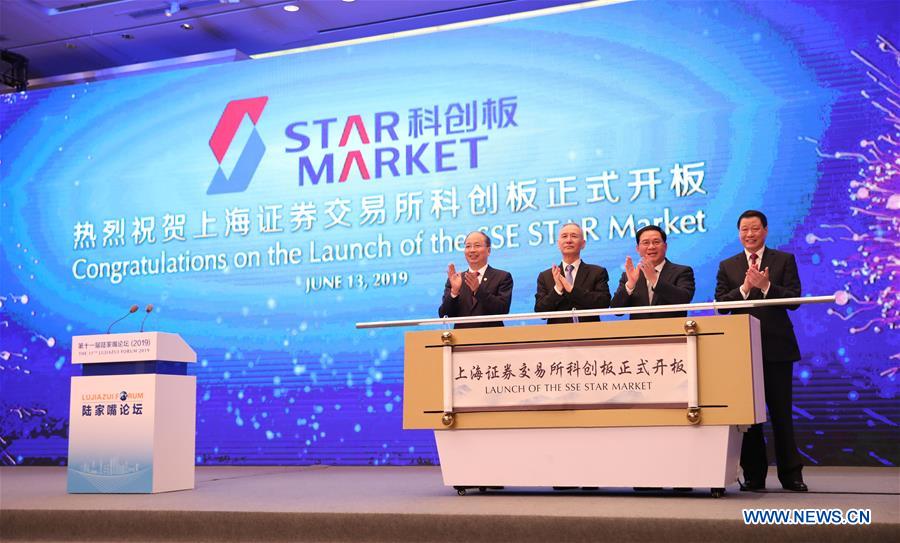
Honored guests preside over the launching ceremony of the sci-tech innovation board of the Shanghai Stock Exchange at the Lujiazui Forum in Shanghai, east China, June 13, 2019. (Xinhua/Fang Zhe)
SHANGHAI, June 13 (Xinhua) -- China inaugurated its science and technology innovation board (STIB) on Thursday in Shanghai, kicking off the country's much-anticipated capital market reform this year.
The new market will support tech companies that are in line with the national strategies, make breakthroughs in core technologies and are well accepted by the market to grow stronger, Yi Huiman, chairman of the China Securities Regulatory Commission (CSRC), said at the launching ceremony of the STIB at the Lujiazui Forum in Shanghai.
Yi said the pilot registration-based IPO system will lead to more regular delistings and is quite different from the current IPO pricing mechanism. Additionally, the market-based pricing for the new board could result in more IPOs at higher valuations.
Yi warned of short-term speculation and huge price swings in the early period when a limited number of companies are traded on the STIB in the Shanghai Stock Exchange. Yi, however, gave no timetable on when the first batch of companies will start trading.
He urged investors to invest more rationally and keep a close eye on information disclosures as tech companies face more uncertainties.
The new board, proposed in November 2018 and approved in January, will provide direct financing support for tech companies and help the world's second-largest capital market spearhead a new round of reforms.
SCI-TECH INNOVATION
The launch, after just months of preparations, highlights China's determination and confidence in using financial reform to aid its science and technology innovation.
Over the past years, many of China's top innovation-driven companies, including Alibaba, Tencent, Baidu and Xiaomi, have been listed in Hong Kong and the United States, said Zhang Chun, executive president of Shanghai Advanced Institute of Finance.
"Many businesses that have strong innovation capacity and make a great contribution to China's economy are absent from the domestic capital market," said Zhang.
"The emerging industries and tech companies are a major source of economic growth, and without their participation, the country's capital market would not have a solid foundation for a sustained bull run," he said.
Globally, equity financing on the capital markets has played a key role in nurturing science and technology innovation. Among the 10 most valuable companies in the U.S., about half are internet and information technology (IT) firms, including Google and Apple.
In China, the new board is also expected to become a new source of support for the country's science and technology innovation.
The STIB is designed to focus on companies in high-tech and strategic emerging sectors such as next-generation IT, advanced equipment, new materials, new energy, energy saving and environmental protection, and biomedicine, according to the top securities regulator.
As of June 10, the Shanghai Stock Exchange had handled 119 applications for IPOs on the STIB. In total, 41 companies, or 34 percent, are in the field of next-generation IT, 21 in the advanced equipment industry, 27 in biomedicine and 13 in new materials.
EXPERIMENTAL FIELD
The STIB has set up more tolerant rules to welcome tech firms in different growth periods and with different equity structures.
"The STIB is undoubtedly a landmark reform for China's capital market," said Zhang, citing listing for unprofitable companies, focus on six major high-tech industries, higher investment threshold, fewer stock price rise and fall restrictions, IPO pricing reform and tougher delisting mechanism.
For a capital market with more individual investors and a less mature market mechanism, it was impossible to implement the registration-based system on all the boards of the market. The STIB thus is becoming an experimental field for China's registration-based IPO system, said Zhang.
It offers a key opportunity to optimize the financing, investment and trading on the capital market and is also a key move to use the market mechanism to promote the country's innovation transition, said Yang Dehong, chairman of Guotai Junan Securities.
Experience in the experimental field can be copied and promoted to other existing boards of the capital market.
Yi said the CSRC will promote experience from the STIB to push forward sweeping reforms of the capital market and build the capital market into a regulated, transparent and open one full of vigor and resilience.
Yi vowed to stick to the market-oriented, law-based and international approach, respect the market rules and ensure the solid implementation of all reform measures.
OVERSEAS CAPITAL INFLOWS
The STIB, with the pilot registration-based IPO system, is China's latest move to integrate with the international markets. With an open posture, China is attracting the sustained inflows of foreign capital.
The new board can help China's yuan-denominated A shares attract more institutional and international investors at a time when global index provider MSCI increased index weighting for China A-shares, according to a research note released by UBS CIO Wealth Management.
FTSE Russell and S&P Dow Jones Indices are also planning to include Chinese A-shares in their global benchmarks.
China has doubled the qualified foreign institutional investors (QFII) quota to 300 billion U.S. dollars early this year. The State Administration of Foreign Exchange has also sped up the approval of QFII and RQFII (RMB QFII) products.
The net inflows of funds through "northbound trading," or money invested from Hong Kong into the Chinese mainland through stock connect programs exceeded 60 billion yuan (8.7 billion U.S. dollars) in January after hitting nearly 300 billion yuan last year.
The investment sentiment has receded since March, but recovered in June, with the inflows of funds reaching 9.6 billion yuan in the first week of June.
Foreign investors remained optimistic in the Chinese stock market, which is more integrated and connected with the international market, according to J.P. Morgan Chase.
(By Xinhua writers Li Baojie, Pan Qing, Yao Yujie, Liu Hui, Sang Tong; Video by Sun Qing, Chen Jie, Ding Ting, Sang Tong, Liu Yuting)
