




Trade conflicts, global uncertainty and the struggling automotive sector have finally brought the German economy to its knees, said Carsten Brzeski, ING DiBa bank's chief economist.
by Zhu Sheng, Stephanie Wolff
BERLIN, Aug. 15 (Xinhua) -- U.S.-initiated trade offensives against its major trade partners have weighed heavily on the export-oriented German economy as well as that of the European Union (EU) as a whole.
Germany's gross domestic product (GDP) shrank by 0.1 percent from April to June of this year from the previous quarter, the Federal Statistical Office (Destatis) of Germany announced Wednesday.
Counting in factors including the uncertainties arising from the ongoing U.S.-China trade disputes, many leading economic research institutes and the German government have cut their forecasts for Germany's economic growth this year.
The whole EU is facing dwindling growth prospect amid growing concerns over rising protectionism, spearheaded by Washington.
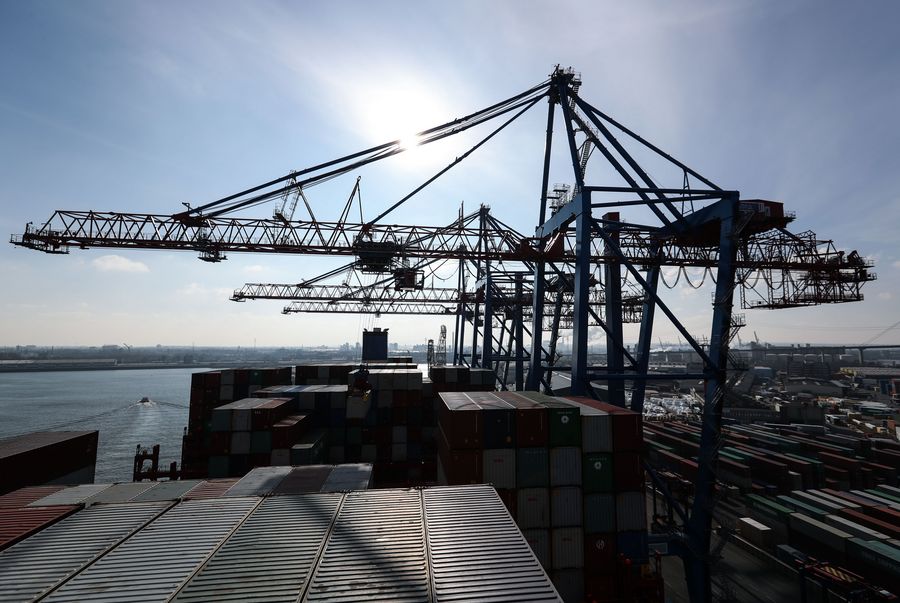
Photo taken on Feb. 23, 2018 shows a view of the port area of Hamburg, Germany. (Xinhua/Shan Yuqi)
WARNING SIGNAL
"The development of foreign trade slowed down economic growth because exports recorded a stronger quarter-on-quarter decrease than imports," Destatis stated in its press release on Wednesday.
The German economy was entering a "more difficult phase," acknowledged German Chancellor Angela Merkel. This was due to international trade conflicts and the "many mistakes" made in the country's automotive industry, a sector that has also been overshadowed by continuing U.S. tariff threats.
Meanwhile, German Minister for Economic Affairs and Energy Peter Altmaier sounded alarm about the GDP growth figures, which he described as "a wake-up call and a warning signal."
In June, German exports had declined 8 percent from the previous year, according to Destatis.
"The export-dependent German economy is suffering particularly from the uncertainties of foreign trade," Thiess Petersen, senior adviser at the German Bertelsmann Foundation, told Xinhua.
The decline in Germany's GDP in the second quarter of 2019 was "therefore not surprising," said Petersen.
Trade conflicts, global uncertainty and the struggling automotive sector have finally brought the German economy to its knees, said Carsten Brzeski, ING DiBa bank's chief economist.
Increased uncertainty, rather than direct effects from the trade conflicts, in particular has dented sentiment and hence economic activity, said Brzeski.

Thiess Petersen, senior adviser at the German Bertelsmann Foundation, receives an interview with Xinhua at the Bertelsmann Foundation in Guetersloh, western Germany, on Aug. 14, 2019. (Xinhua/Shan Yuqi)
DEVELOPMENT STRAIN
The chances for a rapid recovery of the German economy, especially its industry, in the second half of the year also seemed slim, economists believe.
"A decline in the third quarter cannot be ruled out, which would be a technical recession," said Oliver Holtemoeller, vice president of the Halle Institute for Economic Research.
The Macroeconomic Policy Institute (IMK) based in Dusseldorf estimated the risk of a German recession at 43 percent.
"Germany's economy is on the verge of collapse," warned Sebastian Dullien, scientific director of the IMK.
The escalation in international trade disputes, the "risk of competitive devaluations" as well as an increased likelihood of a no-deal Brexit would likely put a "further strain" on German exports and industrial production in coming months, noted Achim Wambach, president of the Leibniz Centre for European Economic Research.
"A recovery of German exports is not in sight. For the year 2019 as a whole, therefore, only a weak increase in German GDP in the range of 0.5 percent at best can be expected," Petersen told Xinhua.
Holtemoeller offered a slightly more optimistic outlook for the year.
According to him, a modest recovery is to be expected provided that the external economic situation does not deteriorate further, because the German domestic situation remained "solid" as the disposable income of private households continued to rise while the labor markets "remain robust."
The German government was predicting an economic growth of 0.5 percent for 2019, markedly lower than the country's GDP growth of 1.5 percent last year.
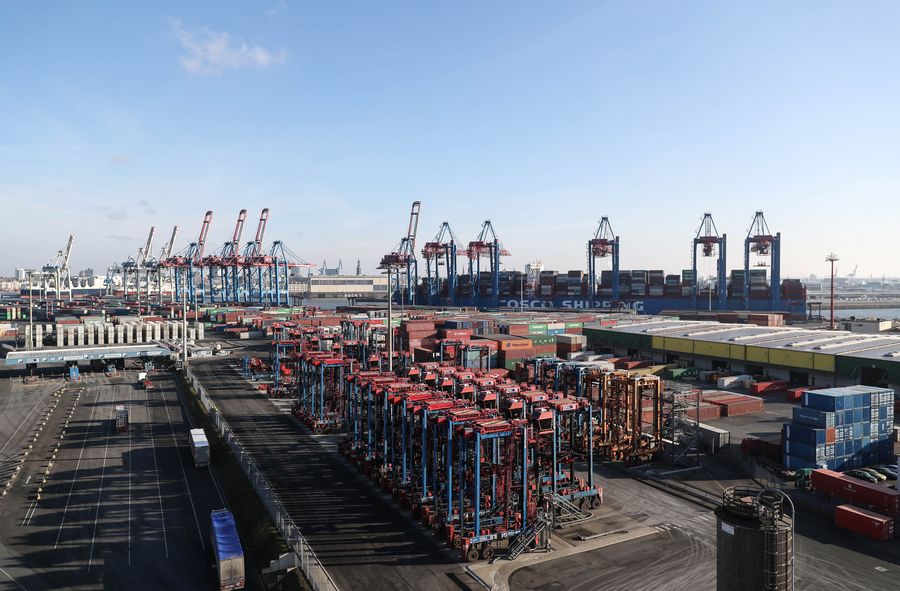
Photo taken on Feb. 23, 2018 shows a view of the port area of Hamburg, Germany. (Xinhua/Shan Yuqi)
TRADE WAR LOSER
Besides Germany, analysts believe that other countries like the Netherlands, or even the entire EU, are also to suffer from the increasing protectionism.
The Netherlands' National Dutch Bank published a report, saying that intensifying international protectionism poses a major threat to the global economy, as a wave of trade restricting measures are bound to drag down global growth and darken the global economic outlook.
Escalating U.S. trade conflicts with other countries will cause mounting financial insecurity and declining confidence and could affect the Dutch economy, according to observers.
According to a study by a German think tank, the increased U.S. tariffs on Chinese imports alone would translate into an additional burden of 1 billion U.S. dollars on the EU.
The Dutch bank Rabobank said in a report released Wednesday that exporters and consumers in third countries might also feel the pinch from a disruption in supply chains between China and the United States.
In an article published on its website titled "The Winners and Losers of the U.S.-China Trade War", the Atlantic Council, a Washington-based think tank, put the EU on a team of losers who would suffer from the ongoing U.S.-China trade frictions.
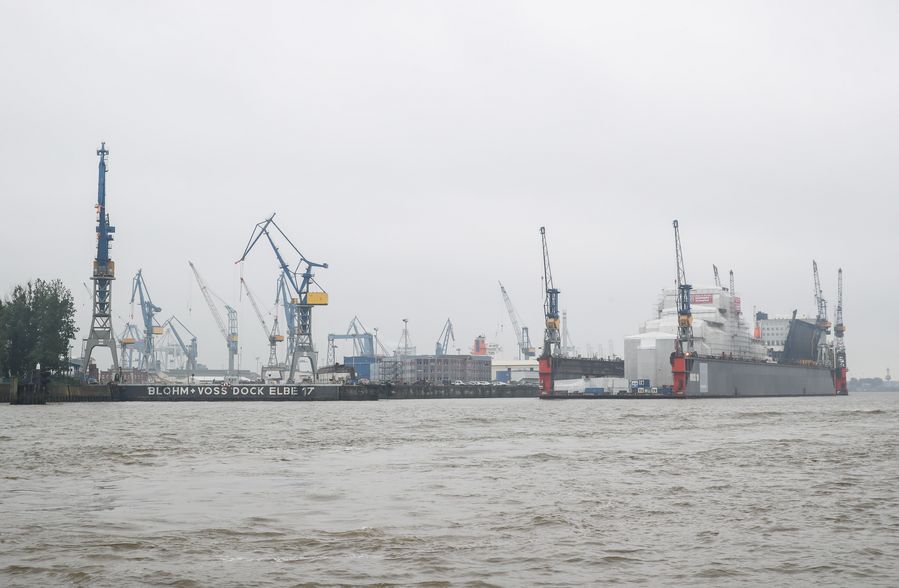
Photo taken on May 21, 2019 shows a view of the port area of Hamburg, Germany. (Xinhua/Shan Yuqi)
There are long-term consequences for the EU economy if current trends hold. The EU economy relies heavily on trade, and the recent slowdown in trade amid the U.S.-China disputes has raised concerns in Europe about future growth. Exports from the EU are worth 40 percent of its GDP, and that number has increased in recent years.
The United States has now become a disrupter of the liberal international order, including the rules-based global trade system, which the United States itself helped create after World War II, said Nicola Casarini, senior fellow at the Istituto Affari Internazionali.
(Xinhua reporters Zhai Wei, Tian Dongdong in Brussels, Yan Feng, Lian Zhen, Shan Yuqi in Berlin, Wang Yanan, Jesse Wieten in The Hague also contributed to the story.)
(Video reporters: Zhu Sheng, Shan Yuqi, Lian Zhen; Video editor: Ma Ruxuan)
