




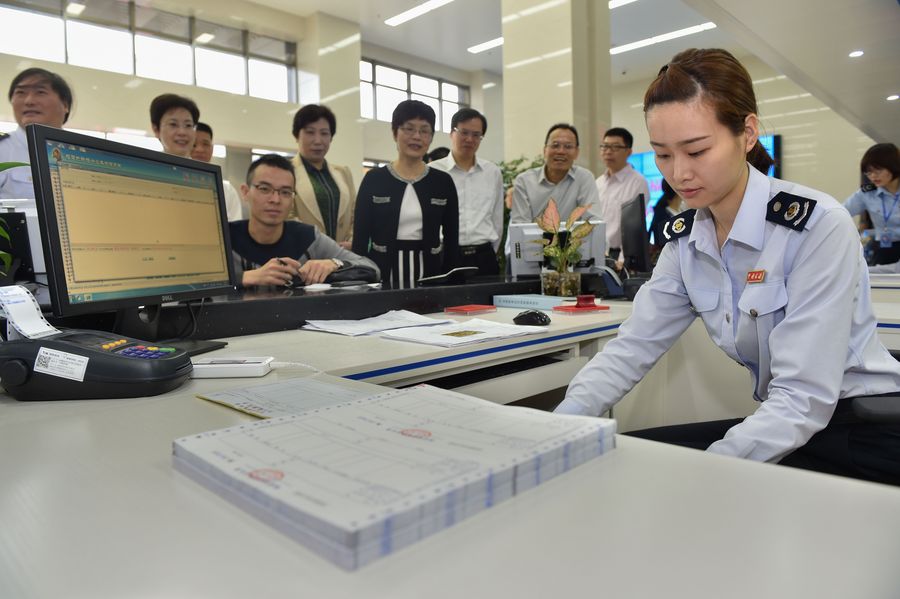
A staff member (R) explains to a taxpayer about a new policy on VAT reduction at a local tax bureau in Fengze District of Quanzhou, southeast China's Fujian Province, April 1, 2019. (Xinhua)
China is implementing the largest tax and fee cut of recent years, saving enterprises and individuals nearly 1.35 trillion yuan (about 189 billion U.S. dollars) in the first seven months of this year. As a tradeoff, governments at all levels are told to "tighten their belts."
BEIJING, Oct. 11 (Xinhua) -- China is pushing forward reforms on the fiscal powers of central and local governments with a high-stake action plan on some of the country's most important taxes.
The State Council, the cabinet, has released a guideline to establish a fiscal relationship between the central and local governments built upon clearly defined powers and responsibilities, appropriate financial resource allocation and greater balance between regions.
The document clarified that the country will maintain the equal split of value-added tax (VAT) revenues between the central and local governments to stabilize expectations and encourage local governments to develop competitive industries and expand tax sources.
China's tax revenues can be divided into three categories: central tax, local tax and tax shared between the central and local governments. VAT accounts for the majority of shared tax revenues.
In 2016, the country implemented a comprehensive reform in replacing the business tax, a mainstay of local tax revenues, with VAT in a bid to ease the tax burden on companies. The reform also replaced the 75-percent-to-25-percent split of VAT revenues with an equal share between the central and local governments for a transition period of up to three years.
A tax official prepares a value-added tax (VAT) invoice of a real estate transaction in Fuzhou, capital of southeast China's Fujian Province, May 1, 2016. (Xinhua)
The new guideline has extended the equal revenue distribution scheme and improved the refund sharing mechanism for excess VAT paid to alleviate local government's fiscal pressure.
The VAT a firm must pay is its output tax minus the input tax. When the taxpayer's output tax is insufficient to cover its input tax, the difference between the two is called excess tax paid. The excess part can be used by a firm to offset taxes in the next taxable period. Companies in some sectors including equipment manufacturing are now allowed to get refunds to buoy cash flow.
Under the previous refund sharing mechanism local governments had to pay half of the refund. Now required to pay 15 percent first and then the remaining 35 percent based on its share of the previous year's VAT revenue.
"Implementing a larger scale of tax and fee reductions is key to cope with the downward economic pressure, and adjusting the division of revenue between the central and local governments is an important guarantee," said Bai Jingming, vice president of the Chinese Academy of Fiscal Sciences.
The guideline came at a time when the growth of local fiscal revenue has slowed down significantly, while the pressure on local governments to maintain steady growth has not abated, Bai said.
China is implementing the largest tax and fee cut of recent years, saving enterprises and individuals nearly 1.35 trillion yuan (about 189 billion U.S. dollars) in the first seven months of this year. As a tradeoff, governments at all levels are told to "tighten their belts."
Bai said the reform measures can effectively relieve the revenue pressure of local governments, especially those with financial difficulties, and ensure the steady progress of tax reduction and fee reduction policies.
The country also plans to shift the collection of consumption tax to the point of sales from the production and import stage, which will in effect boost local governments' revenue and offer them the incentives to create pro-consumption environments.
The consumption tax, one of the central taxes, amounted to some 1.06 trillion yuan last year, or 6.8 percent of the total tax revenue.
Li Xuhong, a senior researcher with the Beijing National Accounting Institute, said the shift would bring far-reaching positive influences.
"Local governments will be encouraged to foster a stronger consumer market, optimize the business environment and facilitate industrial upgrading," Li said, adding that the reform will also pave the way for legislation on consumption taxation. ■
